
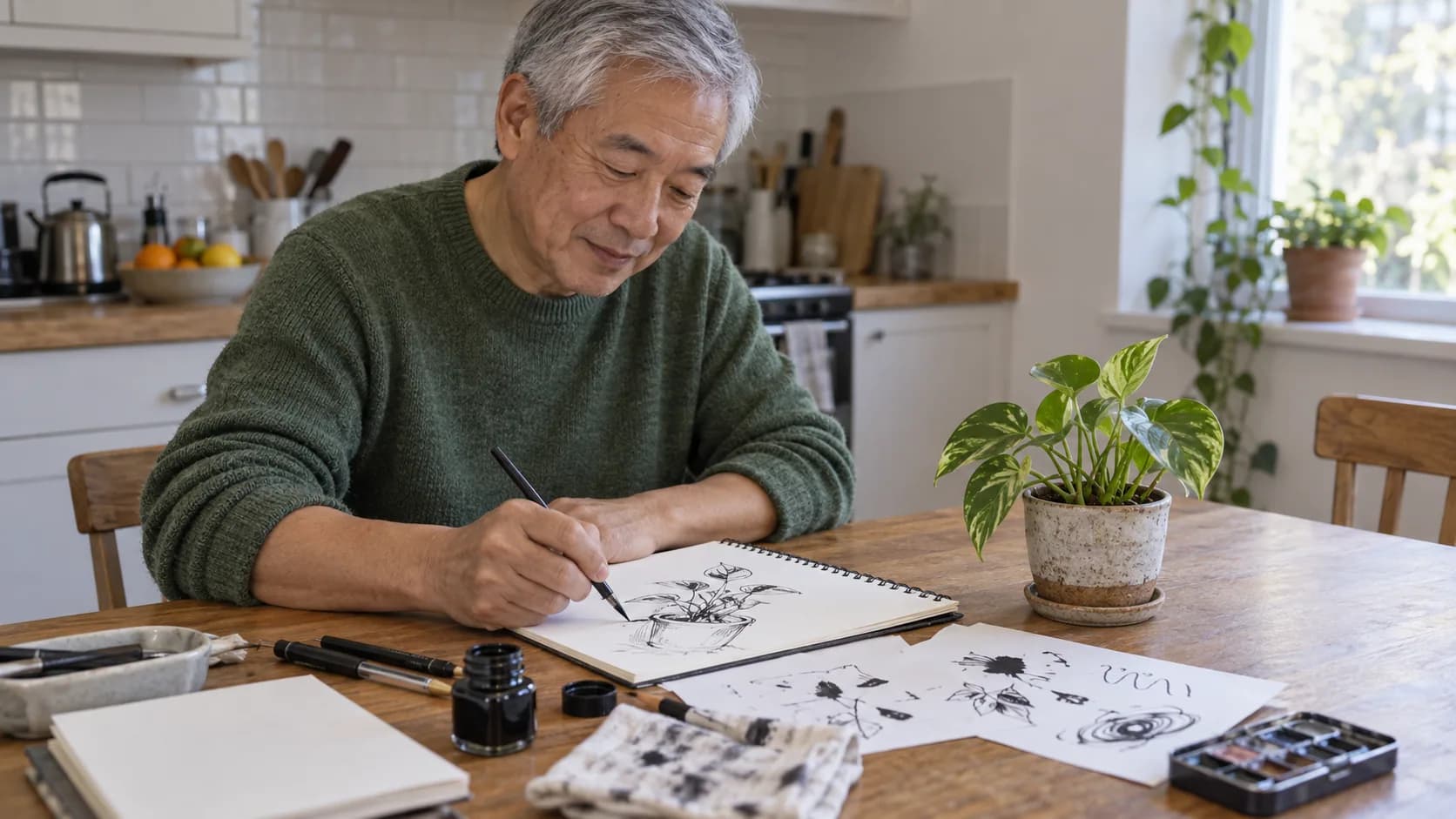
Choose a process you are curious about
Making can include drawing, writing, arranging sounds, working with a material or adapting something you already own. Pick the action that interests you rather than starting with a public identity such as artist or writer. “Describe this room in a paragraph” gives you something to do; “be creative” gives you something to judge.
If you want ideas, the National Institute on Aging’s activity guide includes creative and learning activities for older adults. Treat examples as possibilities to adapt, not a claim that any one activity will produce a particular emotional or health result for you.
You can use ordinary subjects. The work does not need to explain recovery, disclose painful experiences or communicate a lesson. A practical observation, imagined scene or pattern can be enough material.
Decide how much structure you want
Instruction can help when you want to learn a technique. Experimentation can fit when you want to see what happens with a material or idea. A group can provide company but also adds schedules and social expectations. Choose the format that serves your purpose today.
If using instructions, check the actual starting requirements and safety guidance. Do not improvise with tools, chemicals or materials whose risks you do not understand. A simpler medium may be more appropriate for the space and equipment available.
If joining a class, ask whether beginners are expected, what materials are included and whether sharing work is required. You can be interested in making without wanting a public critique.
Make the setup small enough to use
Choose a workspace and a way to put materials away. Include cleanup in the time available. If space is shared, agree when it can be used and avoid leaving something hazardous or obstructive for another person.
Limit purchases until you know what you need. A notebook you own or a borrowed tool used with permission may be sufficient. If an activity requires specialist equipment, find out whether a supervised introduction is available before buying it.
A first session might be twenty minutes of sketching an everyday object, followed by putting the materials away. The duration is an example, not a requirement. The defined scope keeps the setup from becoming a larger project than the making itself.
Decide what kind of feedback you want
You can ask for technique help, an observation or no feedback at all. “Could you show me how this tool works?” is different from “Tell me whether this is good.” A specific request gives another person a more useful role.
Sharing online is optional. If you do share, consider whose personal details or images are included and whether you have permission to disclose them. Do not let a platform’s reaction become the only reason to continue an activity you otherwise enjoy.
Keep the part that interested you
Afterward, note what held your attention and what got in the way. You might want a clearer instruction, a different material or another attempt at the same process. An unfinished piece can still reveal that information.
If the activity did not suit you, choose another process or stop. If you continue, arrange the materials so the next session can begin without repeating every preparation step.
About this guide
AI-generated editorial image; it does not depict a real person or event discussed in this guide.
Examples in this guide are illustrative, not reported experiences.
SoberSphere provides independent general information, not individual medical, legal or financial advice. No provider referral, affiliate arrangement or specialist review is claimed.